
Search St. Paul Warrant Records
St. Paul warrant records are managed through the Ramsey County District Court system. As the state capital of Minnesota, St. Paul has extensive court and law enforcement resources for public record searches. The city sits in Ramsey County where the sheriff maintains an online warrant search tool. You can also check warrant status through Minnesota Court Records Online or visit the courthouse in person. With more than 500 sworn officers, the Saint Paul Police Department handles a large volume of warrant activity. This page covers how to find and access warrant records for cases in St. Paul.
St. Paul Overview
Ramsey County Warrant Records for St. Paul
St. Paul is the county seat of Ramsey County. All warrant records for the city go through the Ramsey County District Court. This court is in the 2nd Judicial District and handles criminal cases, warrant filings, and related proceedings for St. Paul and surrounding areas.
Ramsey County has one of the best online warrant search tools in the state. The Ramsey County Online Warrant Search lets you look up active warrants by name. This tool is run by the Ramsey County Sheriff and shows current warrant status. It is free to use. Keep in mind that not all warrants may be listed, since some are sealed or tied to ongoing cases. For a full check, contact the court directly or visit in person.
| Court | Ramsey County District Court |
|---|---|
| Address | 15 West Kellogg Blvd St. Paul, MN 55102 |
| Non-Emergency | 651-291-1111 (Ramsey County Dispatch) |
| Hours | Monday - Friday, 8:00 AM - 4:30 PM |
Note: The Ramsey County Sheriff maintains a publicly searchable warrant database that is updated regularly for cases across St. Paul and the county.
How to Search St. Paul Warrant Records
You have several options for finding warrant records in St. Paul. The easiest is the Ramsey County online warrant search. Just go to the sheriff's website and type in a name. Results show active warrants and basic case info. This tool works well for bench warrants and arrest warrants that are currently active.
Minnesota Court Records Online is another free tool. It covers all district courts in the state, including Ramsey County. You can search by name or case number. The system shows case type, party names, docket entries, and current status. Some warrant details may not show up online due to privacy rules, but the case record itself should be visible. For full case files or certified copies, go to the courthouse in person.
You can also call Ramsey County Dispatch at 651-291-1111 for non-emergency warrant questions. They can tell you if there is an active warrant on file. This is the same number the Saint Paul Police Department uses for non-emergency calls. If you think you have a warrant, a lawyer can help you understand your options before you turn yourself in.
Saint Paul Police and Warrant Service
The Saint Paul Police Department has more than 500 sworn officers and about 100 professional staff. SPPD was founded in 1854 and is one of the oldest police departments in Minnesota. Officers regularly serve arrest warrants and execute search warrants as part of daily operations. The department covers the entire city and works with Ramsey County on warrant service.
Visit the Saint Paul Police Department website for contact information and services.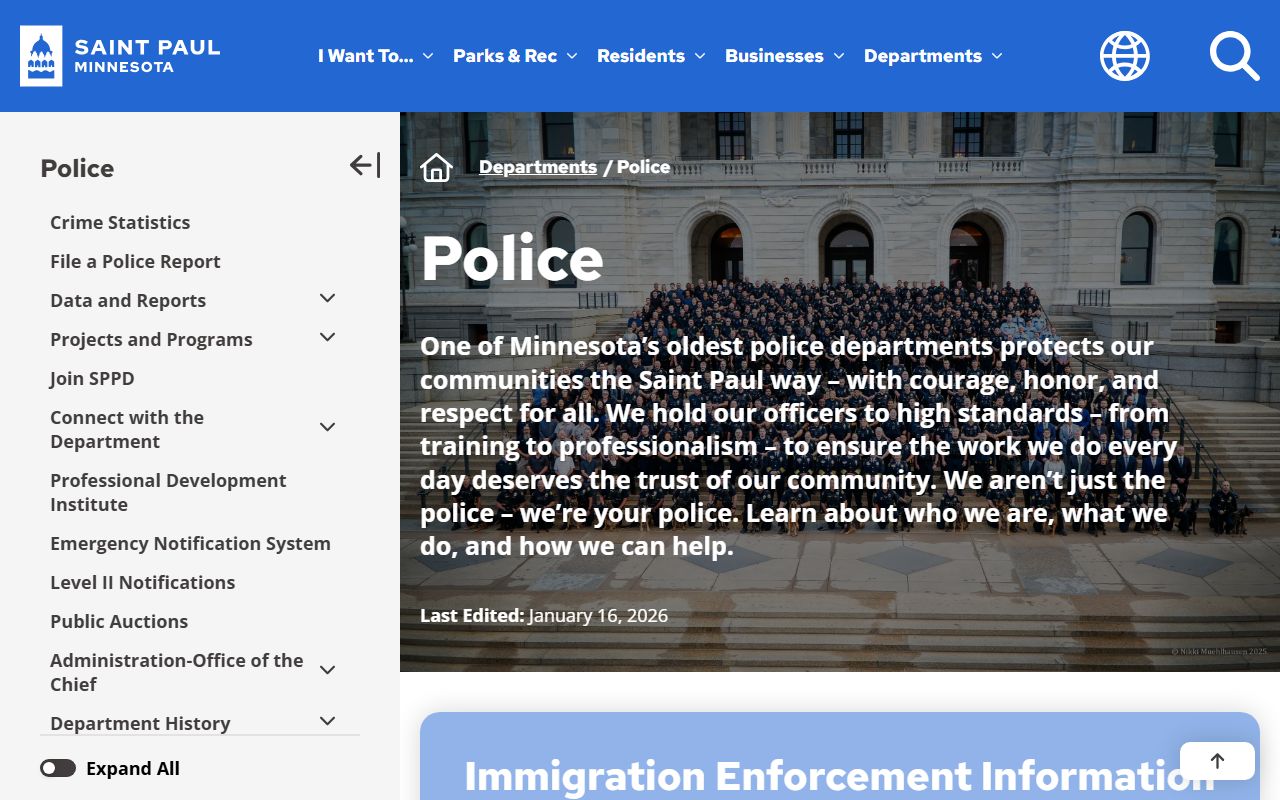
The SPPD site has links to police reports, crime data, and contact details for records requests.
If you need police records from St. Paul, the department has a system for requesting them. You can ask for police reports, arrest reports, and related case documents. For warrant-specific questions, you may need to go through the Ramsey County court system. Under Minnesota Statute 13.82, law enforcement data is classified by type. Some warrant data is public while other parts may be restricted if the case is still under investigation.
St. Paul Warrant Records and State Law
Warrants in St. Paul follow the same state laws that apply across Minnesota. Under Statute 626.05, a search warrant is a written court order that tells a peace officer to search a specific person or place and seize specific items. The warrant must be signed by a judge in the county where the search will happen.
Statute 626.08 requires probable cause for any search warrant. The officer must file an affidavit that names the person, describes the place, and lists what will be seized. This affidavit becomes part of the court record. Once the warrant is served and returned, these documents are generally available to the public through the court system.
Search warrants in St. Paul can only be served between 7:00 AM and 8:00 PM under normal rules. A judge may allow nighttime service if the affidavit shows the items are at the location. For no-knock warrants, Statute 626.14 requires proof that the search can't happen while the place is empty and that someone inside poses an imminent threat. All warrant records are kept by the court and can be accessed through the usual channels once the case is closed or the warrant is served.
State Records Resources for St. Paul Searches
The Bureau of Criminal Apprehension maintains a statewide database of criminal history and warrant information. Under Statute 299C.115, the BCA tracks warrant data from courts across Minnesota, including Ramsey County. You can request criminal history checks through the BCA for a fee.
Since St. Paul is the state capital, many state agencies have offices here. The Department of Public Safety, which oversees the BCA, is based in St. Paul. This gives residents easy access to state-level records offices if they need to check warrant status beyond just the Ramsey County system.
Nearby Cities with Warrant Records
These cities are close to St. Paul and have their own warrant records pages with local contact details and search info.
Each page covers local courts, police contacts, and how to search for warrant records in that city.
Ramsey County Warrant Records
St. Paul sits in Ramsey County. Every warrant filed for a St. Paul case goes through the Ramsey County District Court. The county has a strong online search tool for active warrants and a well-staffed court system for in-person record requests.